

If you enjoy this show and would like to help me spread the word about it, or support it financially, you can find out more at nuancespod.com/support
GUEST BIO
Amanda B. is the executive producer and host of 6 Degrees of Cats, a cat-themed culture, history and occasionally science podcast that investigates the surprising intersections between human and felinekind, with the help of a interdisciplinary roster of guest experts. She has worked internationally in the fields of clinical research, public health, social impact and tech, and is a trained advocate for violence survivors and youth mental health. As a musician, Amanda composes and plays lead guitar in Leathered, an NYC-based rock ‘n’ roll band and has supported major artists on live broadcasts and stages in the U.S. and Europe. Amanda also freelances as a producer of live and virtual professional development programming for clients such as The Podcast Academy. She can be followed on Instagram and Twitter @6degreesofcats and @leathered4ever..
Instagram | TikTok | Twitter | Facebook | LinkedIn
DEFINITIONS
- Rust Belt: a region of the United States that experienced industrial decline starting in the 1950s
- Tabula rasa: Blank slate
- Cisgendered: a person whose gender identity corresponds with the sex registered for them at birth; not transgender.
- Trauma-informed: Trauma informed, which is a buzzword, simply means that I have training and education, understanding the neurobiological holistic impacts of Big T trauma, which is different than the way we use the word trauma in our common language, on the way we expect people to react.
MENTIONED
- RAINN
- OkaySo
- Right to Be
- Womankind
- Center for Anti-Violence Education
- Restore NY (fka Black Women’s Blueprint)
- Anti-Violence Project
- Kimberlé Crenshaw
TAKEAWAYS
- The reasons behind toxic masculinity is different for men with oppressed identities, versus men who are part of the majority, and we need to acknowledge that difference if we want to meaningfully address the problem.
- Consent is not something that you give once and is valid forever. Consent has to be given every single time.
- If you wouldn’t ask the same question to a non-adoptee, then don’t ask it to an adoptee either. By the same token, if you wouldn’t ask a question to a white dude, (eg. where are you really from), then don’t ask it from a POC either. It comes off as ignorant.
- We do our most compelling work when we embrace who we are and all our quirks. See Amanda’s 6 degrees of cats or Ivy Le’s FOGO: Fear of Going Outside
CONTACT
Instagram | TikTok | Web | LinkedIn | Twitter
Host: Lazou
Additional Music Links:
Nuances Podcast – curated Spotify | Apple Music playlists with past guests, hosts & more Asian diaspora artists.
SPONSOR
Featured song: “Nuances” by LAZOU
Video with captions
Transcript
Lazou: Our guest today is Amanda B. Amanda is the executive producer and host of 6 Degrees of Cats, a cat themed culture, history, and occasionally science podcast that investigates the surprising intersections between human and feline kind. She has worked internationally in the fields of clinical research, public health, social impact and tech, and is a trained advocate for violence survivors and youth mental health.
As a musician, Amanda composes and plays lead guitar in the New York based rock band Leathered, and has supported major artists on live broadcasts and stages in the US and Europe. Amanda also freelances as a producer of live and virtual professional development programming for clients such as the Podcast Academy.
Amanda, thank you so much for doing this. Welcome through the show.
Amanda: Thank you so much. I’m so happy to be here. I love your show and I appreciate what you’re doing for the entire community across the Asian diaspora.
Lazou: Thank you. We have a lot to talk about, so let’s start from the beginning. Do you wanna share a bit about your story?
Amanda: Oh there’s so many stories. Everybody contains multitudes. I’m East Asian, my ethnic background is Korean and I’m a transracial, transnational adoptee, I use those two words intentionally because there are actually non-trans national adoptees who are Korean, adopted from Korean biological families into homes in the same nation, for example.
And I hadn’t realized that distinction until I read a couple books by adoptees of that experience. I was raised in the Midwest of North America, although the Rust Belt apparently is the better distinction.
I studied psychology after a brief foray into astrophysics at the University of Michigan.
I have always been very passionate about the world and human connections, exploring connections. So my podcast, 6 Degrees of Cats, connects my affinity for and love of one specific animal, the household cat. I think the patterns across history and cultures that I’ve noticed connect us all together in really surprising, unexplored, very unique and quirky ways.
I get paid to do educational programming, community kind of stuff, and certainly I try to channel everything I do in ways that help uplift voices that are underrepresented under celebrated and under resourced. So that’s me in a nutshell. I go by Amanda and I love cats.
Lazou: Do you wanna talk a bit about your story as a transracial, transnational Korean adoptee? What was that like for you growing up?
Amanda: It’s interesting to phrase that question cause it’s all I’ve ever known, so I’m aware of the common norm and I suppose I should answer that with respect to the standard. So I was raised in a nuclear household as many transracial transnational adoptees of the East Asian experience have been, primarily because it’s a privilege to be able to adopt children internationally.
My cohort at the time was during the eighties, which was the peak when we started seeing almost a cottage industry or international flow of children from various international locations that had been impacted by conflict that had arrangements with local governments to those newly adopted countries.
So I like many transracial, transnational East Asian adoptees. I’m gonna call ’em adoptees for short ’cause that’s gonna be a long mouthful. I was adopted into a white Judeo-Christian leaning two parent household. Specifically Protestant in my family’s case. They were straight cisgendered and two people working full-time.
I have a younger brother who is biologically related to my parents. One of the demarcations of my experience, which is shared with other transracial, transnational adoptees, is that I was one of very few people who shared my ethnic background in my immediate community. I’m not gonna name the town, but I will say, if you’ve seen the film, Napoleon Dynamite. It gives you a sense of what the population looked like and also the socioeconomic distribution based on what I saw.
Further, if you mix it in with a little of the grit from Welcome to the Dollhouse, like the kids that Don Wiener was around, and Freaks and Geeks a little bit. You’ll get a sense of what Rust Belt adolescence as a non-white person may have looked and felt like.
Lazou: So did you have any connection to Korean culture at all growing up?
Amanda: I did. This was a really wonderful thing my parents were able to give. The most immediately proximate large city had a large concentration of kids who were adopted. That adoption agency, Holt International, which is a Christian organization started by Christian missionaries. They would produce a thing called Culture Camp, which was a week where families were invited into a day camp. You could choose, you did not have to go to the camp that was specific to your ancestral culture, which I thought was kind of neat.
We would have guests from the actual culture. What’s interesting too is that the major city proximate to where I was raised had a small community of immigrants from South Korea. Incidentally I also went to a church that had Korean Americans there.
And so, I did have some connection and exposure a little bit. Certainly, of course, the Asian kid go to the Korean restaurant, which is usually staffed by non Korean people, adapting food. But certainly I was taken to some of the more actual like immigrant run or Korean run restaurants and had my share of kimchi.
Lazou: So, you know, As you mentioned that’s your normal for people like me. Um, Not so much I. I have a very different experience from you, so I wonder if there are any particular questions or comments that people might make that seem innocuous to us, non-adoptees, but would grate you a little bit as an adoptee.
Amanda: I love that question also I love your background. I think that one thing we really need to name here, and you do a great job in your podcast is there is no monolith. Like we are all clustered around these really trivial categorizations that really they were forced upon us.
A lot of those questions are wrapped into the overarching problem, which is how misunderstood and just no air is given to the East Asian American experience in general.
There isn’t specific specificity given, we’re defined by what we are not. There’s an adjacency to whiteness, which seems intrinsic to asianness, which I bristle at that. That’s a positionality that is not an identity. And I don’t like being called white adjacent. Whiteness has nothing to do with who I am. It just shows me where I can and can’t go. And my behaviors don’t define entirely who I am. But I think the primary questions misunderstands the construct of family.
I took one of the most impactful courses at University of Michigan, which was the biggest turning point, and this is relevant to the here and now because University of Michigan was a hotbed of affirmative action at the time that I went to college. We were all required to graduate with I’d say five to eight courses that had been co coded as race and ethnicity. And this was to reinforce the school’s belief at that time that it was critical if you were coming outta that institution to literally have exposure and understanding and an awareness of other lived experiences with respect to race and ethnicity and culture.
So I took this course called The History of the Family of the United States only because it was like a five credit media course that I could get outta the way. I entered Michigan with absolutely no interest, passion, or in particular nuance into identity. I don’t think anybody was equipped with those tools at the time.
I had no understanding of how politics informed the way that we have been forced and defined and how that reverberates and is perpetuated. We assume that the way things are are natural or just the way that they happen, and in fact not at all. Those are all because of very specific political and socioeconomic interventions. So through that I came to understand myself as an East Asian person. I understood how Asian male masculinity has been directly impacted by laws that prevented East Asian men, specifically Chinese, there weren’t too many others, although fun fact, the first Asian to put a boat on North American shores was Filipino, which is an interesting, fun fact. Right? Love that stuff.
History’s so cool. Why do they wanna hide it? But let me come back to what I was saying. So that legislation led to what a lot of East Asian men, like my husband, experience. And it has nothing to do with any inborn traits. We are socialized and trained and reinforced by every single message we receive through all sensory perception receivers that we use to inform our experiences, that’s what shapes their experience. So coming back to the family question and the questions about East Asian adoption, there’s assumptions that are made about nurture versus nature.
You know, I had a great aunt, sweet lady, didn’t get out a lot. She’s a product of her times. I’m okay saying that doesn’t excuse anybody, but she’s passed away and I don’t like punishing people for their past selves when they’re not even here. But she said, will she ever learn to speak English about an eight month old infant who’s being brought to North America and to be raised by my parents?
Now, it seems absurd right now, but at the time we certainly didn’t have psycholinguistics. Steven Pinker was still doing groundbreaking research about how babies learn language and how the brain is not a tabula rasa, but in fact is a living, breathing organism that receives information and adapts to its environment and is primed to learn language, which is just a cool thing to know.
Now we’re in a space where understanding identity relationally is the key. Asian Americans are having a hard time co-locating themselves. There’s a difference between I feel like I’m part of this community versus I am seen as part of this community by person X, Y, or Z. I don’t feel like I am part of the East Asian community when it comes to conversations about second generation experiences, the immigrant experience. Technically speaking, I am an immigrant. I don’t have the same experience as say, working class, blue collar Hmong folks in Texas.
You know that’s a dramatically different lived experience. I have more in common with the Rockefellers. Maybe not, but you know what I’m saying. It’s like a big, there’s a wide gulf and so I think a lot of the questions I get stem from that assumption A, that I just fall into that cluster and then that natural family unit, is mine. So it’s really just naive questions about nurture versus nature and also belongingness. It’s such a wide spectrum of questions I get that land a little weird or I’m not sure how to answer. Nobody’s a bad guy, but it’s hard.
Lazou: Yeah. Are there specific questions that you get that you would. prefer that they were rephrased in a different way
Amanda: Sure. This one’s not unique to being adopted, but certainly like, where are you from or what’s your nationality? It’s like the definition of nationality is what’s on your passport. So it’s
Lazou: that would be American.
Amanda: Yeah, I think questions that have an underlying expectation or assumption that I had a certain experience.
Were you close with your parents? Would you ask that of anybody? What kind of answer are you expecting to get? I think people don’t really ask a question understanding deeply what they mean. So maybe just phrasing, you know, where did you grow up is an interesting question that might get the answer that people are trying to get at when they ask those questions of other people. Not asking about like your child home, at first, like that, that just seems like basic decorum. Yeah. Where are you from? Are those your real parents? Do you feel connected to them even though they’re not your real parents? I don’t think people really say it as much, but Yeah, of course those are really annoying questions.
Lazou: Yeah. The questions that make assumptions that somehow your relationship to your parents should be different because you’re adopted.
Amanda: Exactly. Exactly.
Lazou: Since joining TikTok, I’ve heard a lot of very strong opinions about transracial adoption. I’ve seen a lot of people who are very strongly against it. And also people who are very strongly for it. Both sides. What’s your personal opinion about it? What are the pros and cons that you feel strongly about?
Amanda: Sure. I’m coming from a perspective that’s very research informed because when I was an undergrad in Michigan and I changed my major, I actually was a research assistant on a project that analyzed family dynamics in transracial adopted families. So that was actually an interesting question that I got even then.
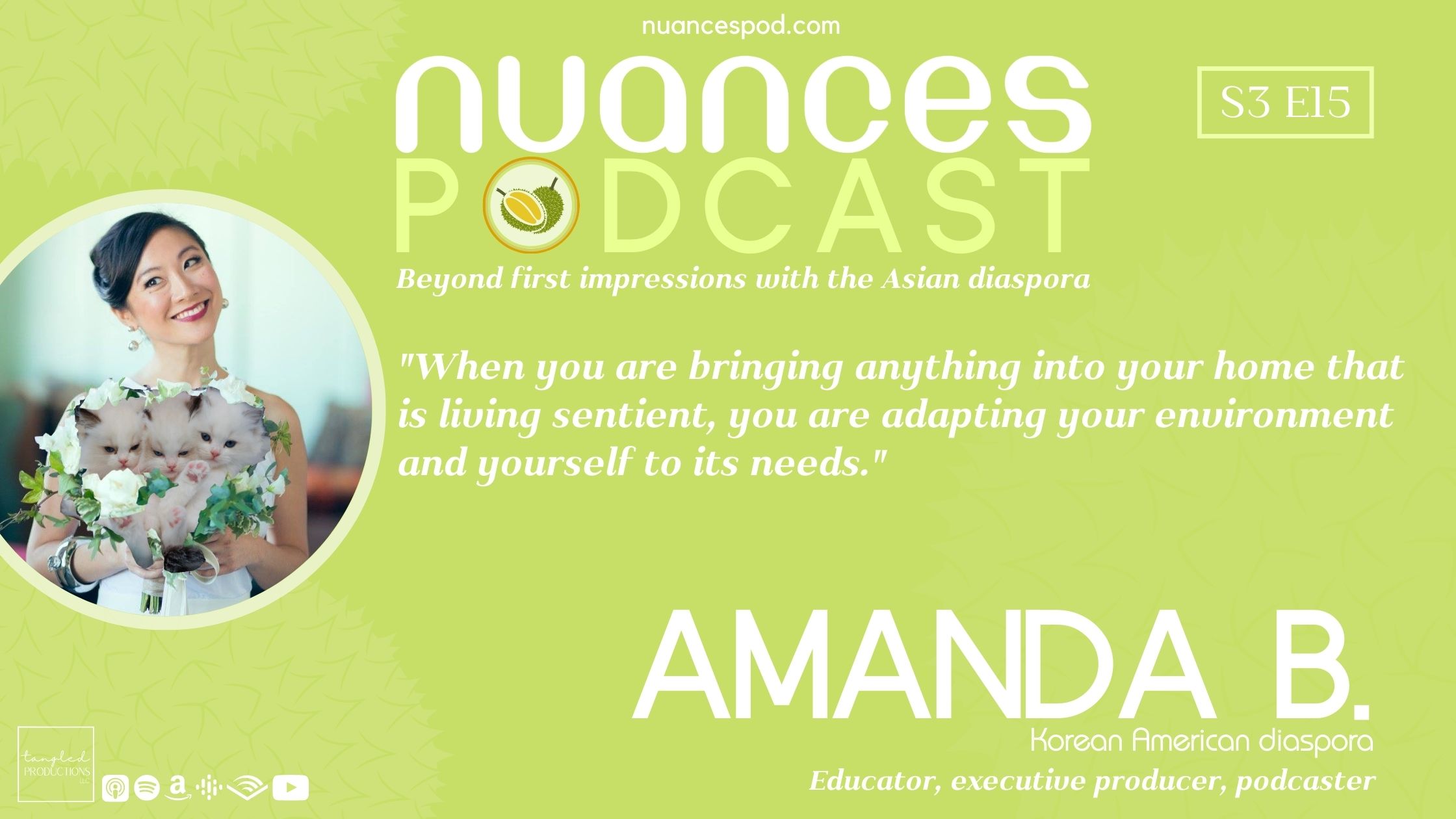
When you are bringing anything into your home that is living sentient, you are adapting your environment and yourself to its needs. Okay so, plants, cats, humans. Okay. I am equating them all because we have to start somewhere.
You are not absorbing it, you are equally becoming part of that community. All right? Or you should conceptualize it that way. When you come from that mindset, I think you’re gonna avoid the pitfalls of the, I’m erasing this child’s culture. Assuming, and centralizing, forgetting um, that I am in such a position of power that I can’t acknowledge their experience.
I really dislike the word empathy. That’s a really big hot take. I think empathy and sympathy are the same side of a coin. That is the early pre-step in trying to make a decision on what you’re gonna do with the information you have. Empathy just means, I’m gonna see, do I have a lived experience that can help me connect to these feelings instead of driving towards compassion, which should be the ultimate outcome. It makes people think, oh, I would do this if I was them. Terrible instinct that serves nobody. Do not lean on empathy to guide your feelings. Use humility. So part of that humility as well is if you’re an adoptive parent or you are becoming friends with somebody in a community you don’t know, if you really care, you’re gonna try to understand you’re an interloper in their culture. They’re a piece of that community that you’re bringing. So this is sensitive because we don’t want people being culture vultures or hovering, or interlocuting into community spaces they’re not invited into. But I would encourage folks to do a lot of education, embrace and hold onto their community’s priorities as your own because they have become your own concerns.
If I were to adopt a child from another community, indigenous, black, latine. Already I care. Those are important conversations to me and inform how I have a relationship. But now, if I have a member of their community in my care and in my viewpoint, they must be my priority. It’s not either or. It has to be part of the process. So that’s my personal opinion. I think the pros and cons stem from accepting that responsibility, acknowledging it, recognizing it, knowing what to do with it or rejecting it.
Lazou: Yeah. That was great. Thank you.
Now switching gears a little bit. You are a multi-talented woman. You have done so many things.
Amanda: Says the multi-talented woman doing tons of things.
Lazou: Talk a little bit about your career so far and how your various interests have gotten you where you are now.
Amanda: As I mentioned, community connection, curiosity, those are the through lines of what spaces I feel welcomed into and what spaces I’m drawn to.
Which sometimes aren’t the same. I think creativity as well is another. I started my journey always being interested in the arts. I loved visual arts as a kid. I think my environment forced me to be very introverted and inner seeking and not withdrawn, but interior So I was really into like painting and I really love film.
I can’t remember the shift when I decided I wanna play guitar, I think it was ’cause I took piano lessons. They were really structured. I wasn’t actually a great student. A kindergarten friend of mine took classical guitar very seriously and told me about this instructor.
So I started taking classical guitar lessons he changed my life. Paul Vondiziano, this beautiful human from Cyprus. And so he really helped me connect to my creative self in a much more expansive way. So I went to college, however, ’cause I talked myself out of wanting to pursue art as a career. ’cause that’s just what a good kid does.
They don’t, I didn’t even get that external pressure. That’s the funniest thing. My parents were just happy that I got good grades, kept my head down and they knew I had other stuff going on to worry about. Like they were intuitive enough to know I was not happy. I really. I wasn’t bullied severely, but my God, I felt like I was suffocating my K through 12.
It was just not an environment where I thrived psychologically, I still did fine. I got into college and everything, I did study initially astrophysics and astronomy. ’cause I just love those big picture questions. I was so inspired by these deep, passionate thoughts and I wanted to learn more.
And I like the idea of understanding the universe in a structured, interesting way, the pattern detecting. So that’s where the connection comes in. That didn’t work out. I also am a very social creature. I had four jobs while I was on campus, . When I got an A plus in my psych classes, I was like, I think this is a sign from universe, speaking of which, to pivot.
And that’s what led me to do that research project. And then also just continue on the path of developmental psych. Specifically research not as a clinician. So I did that, graduated earlier than I thought I would. Got into a program that brought me to Asia in Japan. I lived there for five years and that was also a life changing event. That’s probably what really crystallized my identity as East Asian. It really changed how I felt about myself, the space I felt like I was allowed to occupy. Went there, got into education, ed tech training, learned that was actually my talent, public speaking designing educational experiences in community management. And that’s taken me all over. I’ve had multiple different roles, directing, supervising educational programming, and just trying to connect people. And then in the background, I’ve always had a band and this podcast that I have six degrees of cats really coalesces all of my, what’s up here?
And my quirky, weird personality, I’m embracing it now. I thought I’d get more normal as I get older. No, I got, I’ve gotten weirder and it’s okay. It’s the best part of getting older.
Lazou: I love it. I love that you’ve found a way to coalesce all of those things that you’re interested in and make the most of your personality. I think your show is the culmination of that. I’m not even a cat person and I love your cat show.
Amanda: Oh my God. That’s the quote I want. It’s did y’all realize there’s so much to know? Oh, thank you that that really made my week. You’re the best. Happy Friday indeed.
Lazou: Now you’ve worked in mental health, sexual health, gender-based violence prevention. What are some common examples of gender-based violence that we should be aware of? I think for a lot of us who maybe have not been exposed to that, we don’t even know what that looks like or might not even register that some things are red flags.
Amanda: Thanks for giving me space to talk about this.
In a nutshell, gender-based violence includes any type of violence where you are specifically vulnerable because of your gender presentation, identity, or I can think the power and privilege is imbued to you in your society or your community.
So when we think about gender-based violence, I like to use the word power-based interpersonal violence to be very specific. Because power-based violence means if you have structural power, if you have physical power, if you have systemic or legal power over somebody else that makes it nearly impossible to give what we call informed, enthusiastic, present consent. And so the absence of that leads to people feeling powerless, harmed, hurt, not there, not engaged. It’s very demeaning and dehumanizing.
And so there’s statutory aspects, like age and other types of things that just really make things very complicated.
Kimberlé Crenshaw is an amazing researcher, k i m b e r l e, with a accent, aigü above her e Crenshaw, and her principles of intersectionality are vital.
So the gender-based violence movement is rooted in the anti-alcohol movement, prohibition. And this is the fun part about social justice. It’s all coming from a mix of really good and really bad ideas. But basically it was because women back in the day, some of whom did not believe in racial equity, some of whom were pretty not great, were noticing that, battered women, which is the word we used at the time, were mostly being battered because of alcohol. So they created this movement to combat domestic violence through prohibition. Now that obviously didn’t work because those are really not helpful band-aid solutions, but what sprung outta that was also, in parallel with the various waves of feminism. Now we’ve got a more advanced, holistic understanding of the causes of violence against intimate partners, meaning anybody past, present sexual, romantic, or domestic partner.
So specific to the Asian community, racism absolutely has impacts in the variations on this gruesome theme that we experience. Masculinity, for example, because Asian men, specifically East Asian men, although I’m speaking a little bit outta lane, it means something different to be macho.
There’s different reasons driving macho, hyper-masculine, not helpful behaviors that we’re all trying to counter. But if we talk to them as if they’re having the same reason to be macho and disregard consent and be hypersexual as we do some buff white cis man, you’re not gonna get that message across. And it really doesn’t acknowledge the undergirding kind of harm and pain that I believe drives harmful behavior. The damaged hurt people. So that’s one thing.
The other thing is East Asian Women- you and I both share that presentation- are targeted in different ways by those who see us because of the history of how we were immigrated, and then how pop culture and the media have staged us as exotic and hypersexual in different ways than say the perceived hypersexuality and exoticness of say a black woman was seen.
It’s important to know the history and the context of why somebody is targeting somebody and also why they are being targeted. There’s nothing we should do to change that. It’s just the awareness of that because I’ve noticed a lot of providers, like I read sex education columns a lot, like advice columns. Terrible advice whenever somebody writes in with a question about how should I process this person’s fetishization of my identity or the way that I’m being perceived or treated or expected to perform in the bedroom. That’s a whole other conversation to have, which is like, how do we process sexual preference with respect to the impacts that society has and how we’ve come to identify our preferences and our needs and our behaviors and how we present ourselves sexually. So those are all nuances that deserve a lot of space that we don’t have time for. You asked me a really big question.
I neglected to add, I’m also on the board of a really amazing app called OkaySo.
It’s free, it’s on the apple Store and also Android. And it’s a safe, private, text-based place where folks who are young, however we define that, and also LGBTQ plus, can receive evidence-informed, caring, supportive, non-judgmental responses to questions about sexual, mental health, identity, relationships. Although you don’t have to identify with those communities to access this.
Lazou: Yeah I wonder if you could give some examples of what you would consider red flags that you would tell people, if this is happening to you, you should really start questioning.
Amanda: Absolutely.
If you are in a situation where you and your partner slash partners be, they temporary or long-term, are disregarding your feelings and telling you that they’re not valid or not giving you the time to process and talk them out then that is not a good sign.
I’m talking about times that are intimate certainly. If somebody’s like pushing you, Hey, come on, don’t you love me? You said it was okay last time. Those situations are absolutely red alert that person is not respecting your body or spirit, who you are in this space. So that’s a big one. And also I think, people who don’t want the best for you. And that’s not to say that they’re giving you a free pass on things that they think you could work on, but trust is really important when you’re asking somebody to change. So I think that what they’d wanna do is if you’re saying, Hey, I’m struggling with this, or I’m confused about this, or I’m not sure where this relationship’s going, or I’m not sure if this is the pace that I wanna be at in terms of our relationship.
And you’re not given that space and you’re not given that validation then that’s not a conversation. It sounds like one person is gonna get their own way and the other person’s gonna have to like fall into that. I don’t know if there’s pithy things.
I’m a little bit against rules because you get into this situation where people are like, labeling and saying, you’re a narcissist or you’re gaslighting me.
And it’s important to be able to identify bad behaviors, but it’s also important to make sure both people are understanding the language we’re using. But I think I did describe gaslighting, toxic narcissism. Like the, you have to define what that means for you and the other person before you start using that language.
But yeah. Somebody who doesn’t take your no. Someone who’s rushing you. Yeah.
Lazou: Yeah. So you’ve done a lot of work in violence prevention. What does that work entail and does it change culturally if you’re working, let’s say with an East Asian population? Is your training material adapted to that? How does that factor in?
Amanda: My specific avenue is public health education. I don’t have a social work degree. I’m not a therapist. I have training as a mental health youth counselor through New York State. Really awesome program, but it’s pretty elementary. I also have training from an international anonymous crisis line, which also helped. And I have certification as a volunteer crime victims advocate in hospitals, which is a specific kind of 40 hour training you have to go through, various providers offer it. And I used to supervise one of the programs that did that. I do bystander intervention trainings, which is I think one of the most popular and one of the better ways we can engage people in preventing harm within the gender-based violence spectra. It’s also called upstander. And there’s specific kind of things that you can do that are helpful. And so that’s what my lane is.
Lazou: So what is that?
Amanda: Bystander training? Oh, there’s multiple agencies that’ve created these curricula.
It’s based in research that um, me just named these people Alan Berkowitz, there’s folks at Skidmore who did it on campuses.
So that’s the research that comes, that is informing and it’s based on evidence-informed strategies that you can do as a bystander, as somebody who is not directly receiving or causing the harm to interrupt moments when you notice there might be increasing risk of whatever kind of violence you don’t wanna see or be around.
Yeah. And I’m gonna shout out the providers of that curricula. We have Right To Be formerly known as Hollaback. We have the Center for Violence P revention, I think they’re called. There’s multiple organizations and they’re actually based on indigenous and marginalized communities, non-carceral system oriented organizing to hold their community members accountable without putting them in the system.
There are specificities in terms of the context in which the violence happens that are addressed by different community-based programs. So you have Black Women’s Blueprint speaks to like intimate partner violence survivorship for black women in the New York area. I’m most familiar there ’cause that’s where I practice. Womankind serves South Asian and Asian and East Asian communities here in New York, and then there’s like Voces Latinas These are all organizations based in the community, and they should be community based.
Lazou: Do you have any examples of where you think education is lacking in terms of like sexual health and, all of that?
Amanda: Oh my God. I just have a short answer. It’s all lacking. There’s nothing out there. We are constantly, there’s funding being taken away. We don’t even have the comprehensive sexual education here. It’s all like how not to get pregnant, which is not even relevant to like a good population who would, never get somebody pregnant because they’re not having sex with people who would get pregnant.
You know what I mean? Or in ways that would get somebody pregnant. Yeah, that, that’s my answer to that.
Lazou: Okay. Any recommendations for resources that you actually do like?
Amanda: The providers I named are really great. The Rape and I ncest National Network, R A I N N, is the clearinghouse that’s been contracted by multiple providers and dispatches people based on their geolocation. That’s a really good clearinghouse. R A I N N. If you Google it, there’s a free hotline that’s 24 7. They work with a lot of local agencies to receive help and also resources.
Lazou: Awesome. Yeah, we’ll make sure to include that in the show notes. Now we cannot close out this interview without talking about kitties.
Amanda: exactly.
Lazou: When did your love for cats start?
Amanda: Oh my gosh. I dunno when I’m gonna have to explore them. My podcast, I will definitely say, ever since I was a little girl, I had a little kitty named Ribbons I got when I was six. I had moved to a new town from the suburbs to the area that’s like Napoleon Dynamite I grew up in and he was my little buddy and it’s just been love at first sight. I don’t know if it’s d n a, , I think it’s nature because like my parents were not cat people.
Lazou: So how’d you come up with the show concept and what do you hope your listeners get out of it?
Amanda: Oh my gosh. I, in a fit of inspiration, I pulled together this proposal for six degrees of cats and submitted it to Spotify Sound Up Accelerator for Women of Color and Podcasting in USA’s inaugural pilot version of this accelerator program that’s now been going for like several years.
That’s what pulled it all together. I just I have a million creative concepts going outta my mind. Books I wish I could write poems, songs, everything like that’s just how my brain works. And so I pulled that proposal together, it got in, there were 18,000 applicants and I was stunned that they thought this bonkers, weird little podcast was worthy of one of the 10 seats into the accelerator.
But it was really wonderful. So that’s how that came to be. What was the second part of your question? I’m so
Lazou: What do you hope that listeners will get out of it?
Amanda: I hope they feel inspired, curious, affirmed, a little joy. They connect to the sense of playfulness that I hope everybody has in their lives. We have a lot of serious podcasts out there that talk about animal welfare, that talk about social justice, and those, there’s people doing that a lot better than me. What I’d like to do is just stoke people’s curiosity, connect to a friendly voice who’s nonjudgmental and is like, Hey I’m, I’m a fellow journey person here in this weird world.
We’re just a little lucky to have these cute animals that somehow chose us and are I just don’t understand how people don’t like hats. They’re so cute. They’re so cute. Cute. I don’t understand how you can’t find them cute. I lack that. I cannot empathize with people who don’t see cats as cute. Anyway.
Lazou: But you have compassion for them, don’t you?
Amanda: have compassion for them and that is the, I hope that you feel compassion.
Thank you for helping me answer my question. Compassion is well. Compassion for the fact that we’re all just trying to figure out how weird and confusing and scary this world is. We’re still naked primates in a cave. Bumping into each other, stepping on each other’s toes, fighting for resources. We just have fancier tools in tech for it.
Lazou: When we first talked, I remember you said you can make anything related to cats, and you weren’t joking. Your podcast has talked about Valentine’s Day, motherhood Vikings, Kosovo. So what have you learned about the relationship between humans and our feline friends as you produced a show?
Did you have some new appreciation for cats and humans?
Amanda: Absolutely. I have been unlearning things. Thanks to the experts I speak to. I will have a set of questions, but if they’re telling me something different I will go and follow them. I unlearned the definition and understanding of domestication thanks to Dr. Melinda Zeder who is this leading anthro archeologist in episode one.
I’ve learned that I’m not, nor should I be expected to be the perfect pet owner certainly. I am misreading my cat’s signals. That’s okay. It’s communication that’s happening. They’re not abused. Don’t worry everybody. I’ve learned that it’s only a matter of perspective that we’re smarter or more strategic or more powerful or strong than animals.
It’s literally how you position yourself in that conversation. To cats, we’re idiots. We’re total incompetent idiots. To dogs, we’re idiots. We can’t understand what they’re saying, even though they keep barking the same thing over. To frogs, we’re, I don’t know, we’re idiots. You know what I’m saying?
Like this species centered thinking. It’s just interesting. Of course I’m not gonna centralize cat welfare when I’m trying to decide how to allocate $5 million when there’s billions of people who are suffering. But can I integrate that understanding and think, okay, this is more sustainable if I integrate the understanding of all these creatures in my communities.
That’s what I learned the Kosovo episode. I think that was episode four was really what I was trying to get across in that episode, which I learned through my experts.
Lazou: Yeah, that was a wonderful episode.
Amanda: Oh, thank you.
Lazou: As usual, we’ll close the interview with our rapid fire section, which are one word or one phrase answers you can explain, but you don’t have to. First question, what’s an Asian food that you should like, but don’t?
Amanda: Nato.
Lazou: What’s an Asian food that you’ll never get tired of?
Amanda: Watermelon candy.
Lazou: Oh, I’ve never had that.
Amanda: There’s this Japanese watermelon candy. I can’t remember what it’s called, but it’s just so fricking good. Ugh, I have to look it up. Tastes like bonkers. That’s an eighties throwback.
Lazou: What’s your favorite rock band that you like to listen to?
Amanda: Oh, just one. Oh my.
Lazou: Okay. What’s the one that you’ve listened to the most in the last week? How about that?
Amanda: Okay, the kinks,
Lazou: Who inspires you as a songwriter?
Amanda: There’s two primary, can I name them both Jeff Buckley and PJ Harvey.
Lazou: And finally what’s your favorite episode of your podcast so far?
Amanda: They’re my children. How can I pick one? I’m really proud of the Mother’s Day episode about St. Gertrude. That’s an episode that I was learning a lot in. Because I had a lot of fun experimenting with like sound design and setting the scene. You’ll notice it when you first start listening to the podcast.
Lazou: Awesome. Thank you so much for doing this. It was so great chatting with you.
Amanda: Thanks for having me. It was such a pleasure. I really appreciated your questions. I hope you can derive some good one-liners out of those strings.
Leave a Reply