

If you enjoy this show and would like to help me spread the word about it, or support it financially, you can find out more at nuancespod.com/support
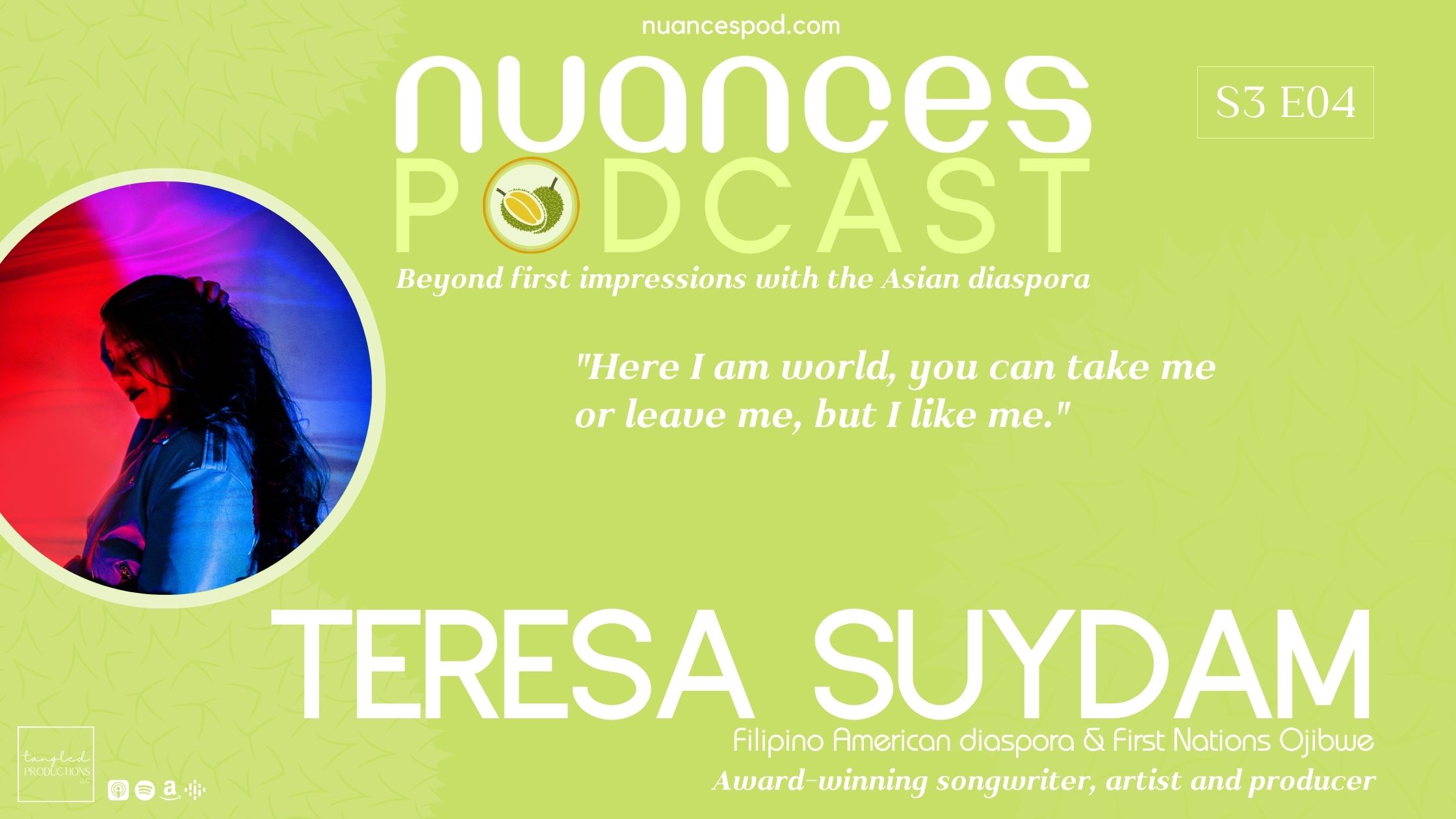
While this podcast focuses on the Asian diaspora experience, we do not exist in a vacuum. I am always trying to weave in new perspectives that foster connections with other communities around us in a way that is authentic to the show. Today, I’m thrilled to have our first First Nations Ojibwe guest, who is also Filipino.
GUEST BIO
Teresa Suydam is a lost bird songwriter and producer of Indigenous and Filipino descent who makes cinematic pop infused with honey-like vocals. Based out of Denver, Colorado, Teresa chases their own culture and identity with their music, and is a safe haven to other multicultural individuals who don’t feel at home in their own skin. In 2022, Teresa’s music video for “Take Me to the Water” was nominated for the Native American Music Awards (NAMA).
DEFINITIONS
- Smudging is a cultural ceremony practiced by Native peoples. It involves burning sacred herbs like tobacco, sweetgrass, sage, and cedar for medicinal, practical, and spiritual purposes. The smoke carries prayers and healing powers. A vessel holds the herbs, and the smoke is guided over the body using a feather (preferably eagle) or hand. Smudging a room involves directing smoke while praying for positive energy and removing negative energy. Ashes are placed outside to symbolize removing negative energy from our lives.
- If you are watching the video of our interview, you’ll notice that Teresa is wearing a headband. They later shared with me that they often experience a sense of disconnection from their community, and seek out means to foster connection. One way they accomplish this is by wearing Native-made jewelry and allowing their hair to grow. They purchased the headband they’re wearing in the video during a powwow.
- A powwow is a ceremony held by Native American peoples involving feasting, singing, and dancing.
- Side note: You may have heard or used the term “powwow” to refer to meetings that are completely unrelated to the original Indigenous context. This is an example of cultural appropriation and is offensive to Native Americans because it strips the word from its great cultural importance.
TAKEAWAYS
- When your people have been driven to near extinction by colonialism and constantly subjugated to brutal treatment, being alive today and occupying space is a form of resistance in itself.
- For people who have grown up with no connection to their roots, it can take a while to warm up to the idea but with the unrelenting, gentle support of their mentors, Teresa did start to learn more about their cultures.
- Sometimes we don’t know what we’ve been missing until we experience it. Teresa had this experience both when connecting with their cultures and when reconnecting with their biological mom and described it as feeling more like themselves, more whole, and more at peace with who they are.
- Learning can feel overwhelming when we know next to nothing, be it a language, a culture, or music production. But it gets easier if we start small and give ourselves some grace to make mistakes in order to learn.
CONTACT
Instagram | TikTok | Web | LinkedIn | Twitter
Host: Lazou
Additional Music Links:
- Nuances Podcast – curated Spotify | Apple Music playlists with past guests, hosts & more Asian diaspora artists.
- Teresa Suydam‘s latest release “Say That You Want Me“
- Teresa Suydam‘s music video with ASL interpretation for “Take Me to the Water“
- Ariadne Mila‘s latest EP “Elemental“
Video with captions
Transcript
Introduction
Lazou: Our guest today is Teresa Suydam, a lost bird songwriter and producer of indigenous and Filipino descent who makes cinematic pop infused with honey-like vocals. Based out of Denver, Colorado, Teresa chases their own culture and identity with their music and is a safe haven for other multicultural individuals who don’t feel at home in their own skin. In 2022 Teresa’s Music video for Take Me to the Water was nominated for the Native American Music awards. Teresa, welcome to the show.
Teresa Suydam: Thank you so much. I’m very excited to be here. I love this podcast and I love what you guys do.
Growing up in Colorado
Lazou: Thank you. Tell us about your background. Where did you grow up and what was that like for you?
Teresa Suydam: Yeah, absolutely. So I am Native American and Filipino pretty split 50 50 down the middle.
I was adopted and I grew up in Littleton, Colorado since I was about two years old. Littleton is very much white suburbia and any of the schools that I went to, I was always part of that very small percentage of the diverse student body. That’s all I really knew growing up. So it wasn’t until I got out into the bigger, wider world that I realized how much of a bubble I was in.
Lazou: Yeah, growing up in a white neighborhood as an adoptee, did you feel like you were part of the white kids, or did you always feel like the sense of you’re different and you were trying to find those roots? Like when did that start in terms of digging into your roots?
Teresa Suydam: Yeah, so I guess for the most part I did feel like I had a place in the community. A lot of that was because I was taller than everybody and I was way more athletic than a lot of people. So athletics came really easily to me. And sports communities can be enormous and people go crazy over that stuff.
I was always good at sports, so I always had a place. Looking back at some of my moments from elementary school, in the class across the hallway from us, another Filipino student transferred in. Everyone was like, "oh, you guys should date."
And I was like, "I don’t even like this kid. Why would I do that"?
Just cuz we were both with Brown Filipinos, they’re like, "oh, you guys go together."
Lazou: You should have said, " dude, he’s my cousin."
Ariadne Mila: Right. They would’ve you.
Teresa Suydam: Yep. That’s so true.
Lazou: A lot of your content talks about the reconnecting with your indigenous and Filipino roots.
Teresa Suydam: Mm-hmm.
Lost bird /feeling home at last
Lazou: What prompted you to start doing that?
Teresa Suydam: It was definitely in college where I started to take those first few inspired steps and they were very hesitant steps.
I went to CU Denver and I think the Native Student Services center just found me through the filter you can do. It’s like "these kids checked Native or BIPOC" or whatever.
So the director found me and sent me an email through my school email. I remember going in. I think she promised me food. So that’s the main reason I went in. And I just.. I was prepared to not be about it at all. I went in and told her a little bit of my background and my story and she just looked at me and she was like, "you are a lost bird."
And at the time I didn’t really know what that meant, and I was offended. So I remember leaving not in the best of spirits, but over the years she just kept emailing me and just being like, " Teresa, do you wanna do this? Teresa, do you wanna do that?"
And since I was down on campus all the time, I was like, "Sure, why not?"
And the more that I got plugged in and the more that I was doing stuff like that, the more whole I felt, the more complete I felt. There was no other way to explain it other than then I just felt more like me. So it started in college and has been going since then.
Lazou: So now what do you think she meant by lost bird? What does that mean?
Teresa Suydam: In Native terms, it is like you’re adopted out of your tribal community. So I am very much that, but I didn’t know anything. And I still know very little in comparison to the grand scheme of things. But I didn’t have a direction or a path and I didn’t have a desire to learn about it. So I was very lost and confused about a lot of things.
Reconnecting with their biological mom
Lazou: Did you know anything about your birth parents?
Teresa Suydam: I knew bits and pieces, so my parents kept an open adoption.
And actually when I was 19 or 20, I did reconnect to my biological mom, and she’s the Filipino side of me.
Lazou: Yeah.
Ariadne Mila: How has it been reconnecting with your biological mom? And I’m curious, how your journey has been with reconnecting with your Filipino side also.
Teresa Suydam: It’s been wild. Going back to when I said I just felt more complete, a similar thing happened.
I was really worried before I met my mom that I would absolutely despise her voice. I dreamt that she had the most annoying voice in my head. But when we met that wasn’t the case and it felt very at home and I couldn’t explain why.
I felt more grounded and that’s been pretty magical since then.
Lazou: That’s awesome.
Ariadne Mila: Yeah. So I’m Filipino and one of our previous podcast guests, Nathan is also Filipino. And that’s one thing that for us, is we’re trying to find ways to fill that kind of void because we’ve felt disconnected. And even my parents have no knowledge of what indigenous groups that their great-grandparents came from, or they can’t trace that because they don’t know.
Teresa Suydam: Yeah.
Ariadne Mila: so it’s tough trying to reconnect to that side. So much of filipino culture is derived from our colonizers. And so getting back to what was ours before all of that happened is really difficult.
Teresa Suydam: Yeah, absolutely.
Filipino & Native cuisines
Lazou: What are some of the highlights or maybe favorite things that you’ve learned about either Filipino culture or indigenous culture since your journey started?
Teresa Suydam: Oh man. I would have to say food,
Lazou: Yeah,
Teresa Suydam: learning about food and getting my hands in and then starting to make things has really helped me
Lazou: so tell us about some of those.
Teresa Suydam: Yes. So Filipino food is fire, wild rice is fire.
And in my family, I’m the baby, so I never really had to do any cooking or they would just kick me outta the kitchen and I would just go play somewhere else.
Learning to cook has been really enlightening for me. And when I connected to my biological mom, without me really asking, she just took my hand. We went to the Asian Mart in her tiny town and she showed me and made me make things. She would just Teresa do this, Teresa do that.
And I have very little culinary skills. Tried very hard, but exploring that has been really a lot of fun. And I feel. I feel very connected through food.
Lazou: What are some of your favorite Filipino dishes?
Teresa Suydam: Ah, lumpia. And, and we all make it differently, right?
Ariadne Mila: yes.
Teresa Suydam: Pancit, I had some good pancit this last weekend.
I’d say a lot of that chicken adobo.
Ariadne Mila: Yeah, classic.
Lazou: Native American cuisine? to be honest, I’m ashamed to say that I don’t know much about Native Cuisine. so what are some things that you like that we should go look up and try to make?
Teresa Suydam: I am also very limited.
One of my Native buddies here in Denver bought me a bag of wild rice, and so I’ve just been going through that. So honestly, the rice is really good. And it’s different from sticky rice.
Favorite cultural traditions
Ariadne Mila: What’s your favorite Native American and Filipino cultural tradition that you wanna share?
Teresa Suydam: On my Native side, I think the finding of your spiritual name is really beautiful. And I was actually just talking to someone about this yesterday cuz their name is Lightning Man. And I was like, how do I go about finding my name? It’s like, you need to find somebody, one who’s experienced in doing that. You give an offering and they speak to the spirits for you and they ask, what do you call this person? And that is your name, I don’t know what that is quite yet, but I really want to learn what it is. So that’ll be the next thing trying to figure out. For me, for my Native side,
Filipino, I don’t know as much. I know I’ve read some really funny marriage things like how your spouse g ets into the family. So I think that has been very entertaining. Something to do with water. Am I in the ballpark?
Ariadne Mila: I’m also not familiar with the water, but I know there’s some, like at weddings, there’s something with coins that they have to do.
Teresa Suydam: Yeah.
Ariadne Mila: and there’s something with a rope. They put a rope around. Not tight it’s on the shoulders.
But yeah, My cousin has a funny story about how like apparently the coins that they were supposed to use during a wedding, they couldn’t find coins, so they used quarters instead.
Teresa Suydam: man.
Ariadne Mila: then somebody used those quarters to buy water, like at the vending machine.
Teresa Suydam: Oh my gosh. What a great story.
Ariadne Mila: Yeah, but there’s some interesting ones. I’m also not, too familiar with the marriage traditions. But I do know the coin story because of this story. So I know the one about the coins.
Teresa Suydam: Yeah. amazing.
Filipino vs Native culture
Lazou: Have you found any commonalities or maybe interesting differences in those two cultures? Do they ever conflict with each other or do you find that a lot of the things are similar?
Teresa Suydam: Gosh, it’s so hard for me to compare sometimes cuz I just know so little.
But I think. Family is a big thing and that just giant family aspect runs deep in both cultures, as it does in many. But I’d say a really interesting thing I learned from my Native Ojibwe side is the clans are passed down through the mothers.
So my buddy that’s out here I’m technically relatives of his mom because we’re both in the same clan.
So I thought that was really cool and really interesting.
Lazou: So what about gender norms then? the gender norms different?
Teresa Suydam: Native is very matriarchal, which is pretty cool.
So that feels good. I feel that in my soul.
Lazou: In what way is it matriarchal?
Teresa Suydam: How clans are passed down through the mothers is pretty big and pretty telling.
But that’s that’s about all that I know so far and I’ve been trying to reach my relatives on my Native side, which again, is pretty hard. I have an idea of which clan I’m in, but I’m not 100% sure of which one.
Lazou: it’s
really hard to trace back where that is.
Teresa Suydam: Yeah.
Yeah. Cause I don’t have much contact with my Native side.
It’s a marathon, not a sprint
Lazou: Yeah. That answers my next question, which was, was it difficult to find information? Sounds like it was.
Teresa Suydam: Yes. Oh my gosh. It’s been so hard and slow, which is not my favorite thing. But I’ve been pretty fortunate in that mentors have appeared in my life when I’ve needed them. Like in college, that one was a really big one. And then when they’ve taken a step back, that’s when I’ve known I need to do a little bit of my own work and a little bit more of my own exploration. The internet is vast, right?
I’m on TikTok. I find Native influencers who I really like and align with. Same, for Filipinos. I read kids’ books because that’s the rudimentary stuff, right? So I’ve been reading through some kids’ books and attending festivals.
There’s quite a few things that happen out here in Denver, culturally. So I try to go to those just to be surrounded by everybody.
Lazou: Yeah. What would be some advice you’d have for people who want to start a similar journey of, finding more about their roots? Maybe some lessons that you’ve learned along the way that would’ve made it easier for you.
Teresa Suydam: I would say to let yourself explore and let yourself feel valid for existing, because for me it’s been a lot. I’ve worked a lot on my inner dialogue that’s " I’m not Filipino enough" or "I’m not Native enough because of all of these reasons".
But once I’ve started doing things on my own and trying to explore things on my own, this last year, I just got into smudging, which is pretty big in Native culture, and my very first time, no idea what I was doing. I still barely know what I’m doing, but I almost set my house alarm off because it was so smokey. But, I’m just allowing myself to handle, handle things like physically see things. I’m trying to get all my senses involved and just see what happens. So I am giving myself permission to do and to make mistakes if they happen.
Lazou: Yeah. So allowing yourself to feel like you’re enough
Teresa Suydam: Yeah.
Lazou: whatever it is that you’re looking for.
Teresa Suydam: Yes.
Ariadne Mila: Western society thrives on making people feel like they’re not enough and capitalist society, that’s how it functions. It’s really difficult to do that work, but that’s almost the key to really feeling whole again
Teresa Suydam: definitely.
Lazou: I don’t know if it’s a western thing, cuz I definitely feel like there’s that in Chinese culture too every time I go someplace where they expect you to speak Chinese, they’ll just speak Chinese to me like Chinatown or. And a lot of times when I, say I don’t speak Chinese like I am, looked down on what kind of Chinese are you?
Ariadne Mila: Yeah.
Teresa Suydam: Yeah.
Lazou: of that everywhere.
I think it’s hard for all of us who are not squarely in the category.
Ariadne Mila: Yeah.
Teresa Suydam: Yes, for sure.
Lazou: Because for me too, I’m like, I don’t know, am I Chinese? I’m not sure.
Teresa Suydam: It is like that, where they’re like, do you speak any other languages?
And I’m like, no, I don’t. And. It feels like immediate disappointment and then I’m disappointed in myself. I’m like "I couldn’t really do anything about that."
Lazou: Yeah, it wasn’t your fault.
Teresa Suydam: Yeah.
Just existing as a Native American makes you a warrior
Lazou: How has that exploration of your identities changed you and how you interact with the world?
Teresa Suydam: I have definitely learned to give myself so much grace.
And that I’ve gained a true confidence about myself and my place in the world. Cuz I used to think to be Native, I had to speak Native be strong, be like a warrior and ride out into battle. And same with Filipino culture. I just, but I mean I am a singer and a lot of people associate Filipinos with being good singers and nurses.
Ariadne Mila: Yes.
Teresa Suydam: I always also felt like I had to dress nice so that people wouldn’t be scared or think down on me. Think that I’m less than. So through this exploration, I’ve definitely gained a confidence and I feel pretty solid now. And I am just like, "here I am world you can take me or leave me, but I like me."
Lazou: what I’m hearing in that is that before you started exploring, all you knew about the cultures were basically the stereotypes that know, the country assigns to people like you.
And then as you explored and you realize that, hey, that’s really not not all Native people are warriors and,
Teresa Suydam: Yeah.
Lazou: Yeah. And that gives you permission to just be yourself. And that’s why representation is so important.
Teresa Suydam: Yes. I’ll never forget one of the first events I attended on campus for Native Americans.
The speaker was like,
" You’re a warrior of education. If you are here, just by existing, you are showing that you are still around even though people tried to get rid of you. And yet we are still here. And that in itself is a miracle."
So that has stuck with me. That’s just existing makes me a warrior.
Lazou: Yeah.
Ariadne Mila: Yeah.
Reclaiming American
Lazou: One thing I’m trying to do with the new season is help reclaim this country because I
Teresa Suydam: Yes.
Lazou: A lot of the narrative about what it means to be american or what an American flag stands for, or what it means to be patriotic has been co-opted by people that I really don’t agree with.
Ariadne Mila: Yeah.
Lazou: and I feel like the progressives have not done a really good job reclaiming that. So what I wanna do is start this conversation on this podcast about, if we were to rewrite the narrative of what it means to be proudly American and what American values are, what would you like those to be?
Teresa Suydam: That is so great. I think it would just be the ability to be confident in who you are and proud of all the pieces that make you you, even if they feel disjointed and messy. Because everyone from culture to culture, from person to person, we’re all so different. Just let us live without the stereotypes, without any of that.
Lazou: Yeah.
Ariadne Mila: I think a lot of us as kids ignore side of ourselves as a survival mechanism. So What would you say to people who are trying to do that work now to reclaim those parts of their identity and feel connected to their cultures again?
Teresa Suydam: Yeah I, would definitely say that it’s a marathon. Take everything in small strides cuz there’s so much information that it can burn you out and make you feel overwhelmed and then almost do the opposite work where you’re just like, "this is too hard, I’m not even gonna try."
So I started with kids books and, those are only like 20 pages long and I reread them over and over and then I was like, oh, there’s an event here this weekend and I just planned to go.
So I intentionally make time to learn, just like any class, just like anything. I am in it for the long haul now and you know, if I have kids one day, I wanna be able to help them so that they don’t have to necessarily feel all the disconnect that I did.
So yeah, just baby steps.
Ariadne Mila: Yeah.
Lazou: it’s one of those things where yes, it’s overwhelming, but at the same time, if you realize that it’s never done right, that there’s
Teresa Suydam: Yes.
Lazou: yes, there’s no achieved.
Teresa Suydam: Unlocked,
Lazou: Next level unlocked.
Teresa Suydam: yes.
Lazou: as long as we’re making progress, that’s good enough.
Teresa Suydam: Yeah, exactly.
And as we go, I feel like just humankind are gonna be more and more mixed, and we’re just gonna be so much of everything.
Learning to produce music
Lazou: Yeah. So all three of us are in music. You are a songwriter and producer. When did you start producing and what made you decide to start to produce.
Teresa Suydam: Oh, I started producing fairly recently. It’s been like one of the most recent things on my journey. And I’ve explored all facets of music. So I started as a songwriter, and then I slowly realized that every time that I wanted to record and release something, I was at the mercy of my producer. And I have so many ideas and I just wanna get ’em out and get them out into the world.
Yeah, one day I I picked a DAW, a digital audio work station. I didn’t know anything about them and I just closed my eyes and picked one. I landed on Ableton and I just learned everything that I could through YouTube videos, through just exploring the DAW itself every single day and learned how to be an engineer for myself.
I did it because I didn’t wanna wait on anybody else. And I know through all the learning that I have done, culturally like, I know I can do this, I can learn from ground zero and just go and it’s never ending but it’s been a lot of fun.
Lazou: That’s awesome.
Ariadne Mila: And it’s empowering too, once you start taking those steps.
Teresa Suydam: And again, it’s just tiny intentional steps
that have gotten me here.
Ariadne Mila: Yeah,
Lazou: Same. It’s one foot in front of the other and then next thing, you look back and you’re like, I walked a lot
Teresa Suydam: Yeah, exactly. It’s so cool.
Lazou: What has your experience been like navigating the music industry, given that, you’ve been doing this a long time, you’ve a lot of roles, what has that been like for you?
Teresa Suydam: It’s been a rollercoaster. I get the most fulfillment from all the different aspects.
There’s a lot of moments when I was just a singer, a "singer songwriter" that I felt people look down on me, they’re like, "oh, when you show up to gigs, all you bring is your microphone and you don’t know how to tell the audio people what you want", stuff like that.
And as I have become my own producer engineer, that’s been really empowering to me that like I am in full control. I can be in full control and no one can tell me otherwise.
Lazou: Yeah, no longer the chick singer.
Teresa Suydam: Exactly. I’m like, I know about decibels and hertz. Please.
Being intimidated to talk to BIPOC
Lazou: Do you ever feel like you have to code switch in the music industry at events that are predominantly white, at least as far as I’ve seen?
Teresa Suydam: I did notice for a while, attending these events since I grew up in white suburbia, I was always comfortable just speaking to them. So it’s almost been like I have to pump myself up to talk to other BIPOC people,
Lazou: Hmm
Teresa Suydam: And that has slowly been going away but for a while I just thought I didn’t have anything to bring to the table. Because even though I am, I look and am brown, I was always intimidated and I wasn’t sure why until I started to dig pretty deep. Now I’m pushing myself to really get involved in these communities more because it’s where I belong, it’s where I need to be as well, and share my story.
Lazou: That’s so interesting that you didn’t feel like you had anything to contribute, What do you mean by that?
Teresa Suydam: Uh, I guess it’s just imposter syndrome. I didn’t feel enough of one thing or the other.
My folks are white, my sister is white, and I’ve made the joke, like a lot of people do, you know, I’m just like a white Native. Didn’t know how harmful that was until I got older. But yeah, I’d just say severe imposter syndrome.
Lazou: Yeah.
Do you think that’s a similar feeling that white people get when they see a group of BIPOC people?
Teresa Suydam: I imagine so. I think I present myself fairly well in public and I still see people cross the street when we’re walking towards each other.
And I’ve tried doing some things like that to other people, to just, to, just to see if somebody would walk by my car, I would like lock it really fast.
And they’d be like, what? Me? And I’m like, yeah, you. Cross the street, get away from you. Yeah, it’s really interesting for my own social experiments.
Authentic self or sugarcoated self?
Lazou: Do you feel like you can openly discuss your experience when it comes to your two, cultures with your peers in the music industry, or do you feel like you have to sugarcoat things or minimize your experience to some degree to make them comfortable?
Teresa Suydam: I 1000% have to sugarcoat things.
Just the, with the situation with my family, being adopted, my family was also adopted and just being mixed and not knowing a whole lot of anything, it’s overwhelming to me. And I know that’s overwhelming to a lot of other people.
So I definitely can’t just bring people into it very easily cuz I don’t know who can hold space for all of that cuz it’s quite a bit.
Lazou: Yeah. Have you found any great allies that you feel you can rely on when you need those spaces?
Teresa Suydam: I definitely have fewer people than I would like.
Lazou: It’s always the case.
Teresa Suydam: yeah, but the ones that are really there and really solid are there for me 100%. But it is a lot. I have a lot of inner dialogue going on still about all of it. And even then I’m like, maybe I should just keep this to myself. Cause it’s a lot.
Lazou: It’s always hard to be vulnerable about these things, especially if you don’t know, these people for a very long time and you don’t know if it’s gonna freak them out.
Teresa Suydam: Yes, absolutely. So sometimes I’ll ease into it and I’ll just be like,
I’m adopted.
My family was adopted.
I have 34 aunts and uncles, maybe even more like 40 cousins. All these things and just see where it goes from there.
Ariadne Mila: See their reaction.
Teresa Suydam: just kinda testing the waters.
Lazou: Yeah.
I think a lot of us in the asian diaspora, you say 30 to 40 uncles like that is not gonna phase any of us.
Teresa Suydam: Yeah.
Lazou: Like we have like hundreds of cousins. Okay.
Teresa Suydam: Yes. And then like even more you just don’t even know of and yeah.
Ariadne Mila: Right.
Lazou: Yeah, Every time someone has a wedding or something, there’s all these long lists of people that your parents wanna invite and you’re like, I’ve never met them
Ariadne Mila: Yeah.
Lazou: Yeah.
but you’re related, so you have to invite them like, okay.
Teresa Suydam: yeah. And at those events you’re just like, so who are you?
Who is your, who are your people?
Lazou:
Representation in music
Lazou: When was the first time you saw yourself represented in the industry?
Teresa Suydam: I think before I really knew that he was Filipino, I would say Bruno Mars.
Ariadne Mila: Yeah.
Teresa Suydam: Bruno Mars was a big icon for me growing up. I think in high school was when I really started getting into his music. And I thought that was a really big deal cuz he was an incredible singer, performer, and Filipino.
I thought that was incredible that I hadn’t really seen before. And for my Native side, I would say I haven’t really seen much at all. And the first time I really learned about Native American music categories in music was last year. And that was when I was in the Native American Music Awards.
I was like, I had no idea this existed. Why didn’t I know that this existed? Then after that, I did a little more looking into it and there’s GRAMMY categories for Native music, but they’re never aired. So nobody knows anything about it. And that really perturbed me.
Lazou: Yeah.
Teresa Suydam: So I’m hoping to help change the game as far as that goes.
Lazou: There totally should be a petition to force the Grammys to air the Native American awards
Ariadne Mila: Yes.
Teresa Suydam: Yeah.
Lazou: Because why not?
Teresa Suydam: Or if it was aired, it’s only aired in certain states.
Lazou: Oh I didn’t know they aired different sections in different states.
Teresa Suydam: I think it does happen. I don’t know how often, but I’ve seen that in some of the Native groups I’m in. They’re like, oh, you have to tune in here to see it, and you have to go through all these maneuvers to get there. And I’m like, this is silly. It should just be there.
Ariadne Mila: Yeah.
Lazou: There’s definitely gotta be a petition out there for this. This should be part of the Grammys.
Ariadne Mila: Yeah,
Lazou: We need to get this, make this happen.
Teresa Suydam: Yes.
Ariadne Mila: It’s really cool when you mentioned Bruno Mars, because that was also one of the first instances that I saw of Filipino representation also.
Apl.de.Ap is also Filipino. I think it’s really cool that it shows that Filipinos aren’t a monolith. Like we don’t all look like Catriona Gray.
Teresa Suydam: Yeah,
Ariadne Mila: so yeah, I I really like that the representation is diverse. Cuz we are diverse.
Teresa Suydam: I think Olivia Rodrigo is as well.
Ariadne Mila: Yes.
Teresa Suydam: Yeah, She’s killing it. Yeah,
Ariadne Mila: Vanessa Hudgins too.
Teresa Suydam: my gosh. Yeah. Yeah. I totally forgot about that. Yep.
Man.
Ariadne Mila: Enrique Iglesias also. Yep.
Teresa Suydam: Ah, I love Enrique Iglesias.
Ariadne Mila: Love him too.
Teresa Suydam: The ping pong song is like my favorite one.
Ariadne Mila: Yes.
Lazou: You guys are everywhere, we just didn’t know that you guys were Filipino.
Teresa Suydam: right? Yeah. Wow.
Lazou: That’s interesting. Yeah.
I think for me, I haven’t seen east Asian American represented that that isn’t someone who looks kind of white,
Teresa Suydam: yeah.
Yes. Mm-hmm.
Lazou: Of mixed people, but not somebody who looks clearly east Asian. The first time I felt represented was, when I learned about MILCK. I don’t know if you guys know her.
She was signed to a major label for a while too, I was like, oh, finally somebody who looks like me, who’s not making just Asian music, who’s making music that I like to listen to. That was so great to see. And that was what, 2018? So it’s very recent.
Teresa Suydam: Oh yeah. That is recent.
Ariadne Mila: Yeah.
Why an ASL interpreter?
Lazou: Yeah. so let’s talk about your music for a little bit. I love that you had an ASL interpreter in
your
music video.
Teresa Suydam: Thank you.
Lazou: How did that come about?
Teresa Suydam: I lost my voice in college for a whole semester when I was doing music.
And literally, all my professors were like if you can’t sing, just think about singing and we’ll just grade you on that. I’m like, oh my gosh. I’m a singer who can’t sing. I can’t even talk. It was just a semester of that, and it was really debilitating.
Ariadne Mila: Yeah.
Teresa Suydam: So it just brought a whole new awareness to me of, people who are deaf or hard of hearing, and it’s important to learn, even just the basics. Everybody should learn the basics of ASL just in those cases where if you lose your voice, If you can’t speak for whatever reason.
And I just brought this to my friend and she was like, yeah, I’m all about it. Let’s do it. So I sent her my lyrics and the music and she created this beautiful interpretation of it. I was like, all right, let’s take a day and let’s do this. Let’s make this happen. So that was in the thick of the pandemic and I really wanted to create a music video but create it in a safe way.
So you’ll see a lot of the shots we are over six feet apart.
So that’s how it happened.
Lazou: That’s awesome. And it’s a beautiful video. We’ll have the link in the show notes if people wanna check it out. It’s a beautiful song. did you produce that one yourself?
Teresa Suydam: That song, I produced it with a buddy in Boulder, I believe. Again, it was in the pandemic, and I just wanted to start releasing music on my own, my solo career. Cuz before that I had been in bands. So it was like, it was my time and I was definitely in the room figuring out the vision. So in that way I was producing, but I wasn’t engineering.
Lazou:
From band to solo artist
Lazou: How has that been transitioning from being part of a band to being a solo artist? Do you feel a lot of pressure?
Teresa Suydam: In a lot of ways I do, in a lot of ways, it’s freeing. It’s been some time now though, so I do miss being part of a band and conglomerate on stage, especially if I do solo gigs, I’m like, oh my gosh, I’m so exposed. It’s scary. But I love doing my solo stuff because I love creating music. Going forward now I’m gonna try and find some people who I can be like, I have a show on this day. Can you play with me just for the day? I don’t wanna do anything super, super hard, committed because everything will be under me and my brand.
Lazou: Yeah, I’ve hired people to come play on gigs before and that’s worked out great. There’s a lot of professional musicians out there who
Teresa Suydam: Yes.
Lazou: you just pay them and they bring in their A game.
Teresa Suydam: I can play a lot of instruments. I’m not the best at them, but I can play them all. And when I just have somebody who’s strictly good at guitar, strictly good at piano, it feels a lot better. So I think that’s what I’m gonna do going forward.
Lazou: Yeah.
Ariadne Mila: Yeah.
Teresa Suydam: Yeah.
Upcoming projects
Lazou: What’s coming up for you music wise? I believe you’re working on an EP right?
Teresa Suydam: I’m working on my first full-length album and also maybe a side ep just cuz the rate at that I’m working with somebody. We’re going quickly, so we might have an EP really quick.
We’ll see. But my primary focus this year is on my full-length album. Which is gonna be titled Lost Bird. And it is gonna be about my whole cultural journey up until now. We’re exploring a lot of sounds and different ways of producing, so I’m really excited for that.
Advice for lost birds
Lazou: So finally, what advice do you. You have for other lost birds out there who might be listening.
Teresa Suydam: Oh, I would just say to shine so bright in what you do and who you are that people can’t ignore you. the world needs that unique experience and perspective. And it’s scary. It is very scary, but it’s very necessary. And for me it’s been fulfilling, I feel more me, more of who I want to be.
Rapid Fire Questions
Lazou: All right. We’ll end the interview like we end all interviews, which is with our rapid fire section. are short one word or one phrase answers. You can explain if you want to, but you don’t have to.
Teresa Suydam: Okay.
Lazou: You ready?
Teresa Suydam: Ready? I’m ready.
Lazou: All right. an Asian food that you should like, but don’t?
Teresa Suydam: Balut.
Ariadne Mila: Yeah, I feel that so hard.
Lazou: What is it?
Ariadne Mila: it is a
Teresa Suydam: It’s a duck embryo.
Ariadne Mila: yeah. Like, how do I explain it?
Teresa Suydam: Yep. it’s very much, you see it as a duck embryo.
Ariadne Mila: It’s formed. Yeah. It’s, it’s quite formed as a
Teresa Suydam: It’s a lot of protein though, what I hear.
Ariadne Mila: Yeah. I have not been able to warm up to it.
Teresa Suydam: Yeah,
Ariadne Mila: but my family loves it.
Teresa Suydam: Yep. Can’t get past it.
Lazou: Okay. What’s an asian food that you’ll never get tired of?
Teresa Suydam: Rice
Lazou: That was my answer too
Ariadne Mila: Yeah.
Lazou: what’s a native American food that you’ll never get tired of?
Teresa Suydam: also rice.
Lazou: Name someone in the Asian diaspora who you look up to?
Teresa Suydam: Is it cheesy to say you guys?
Ariadne Mila: that’s so sweet. Thank you.
Teresa Suydam: I mean, I love, I listen to the podcast. Yeah.
Lazou: Thank you so much.
Ariadne Mila: Yeah. Thank you.
Lazou: and who in the Native community is inspiring you right now?
Teresa Suydam: My mentor, Deborah Hunt, she was also at the Native American Student Service Center.
So
Lazou: Shout out to Deborah. All right. Before we let you go, do you wanna let people know where they can find you, where they can find you music, your Patreon, and all of that stuff?
Teresa Suydam: yeah, so everything is. At Teresa Suydam, t e r e s a s u y d a m.
I’ve claimed every part of social media under that name. And on Spotify it’s the same thing. Apple Music. I’m probably the most active on TikTok and Instagram, and you can find all my Linked trees to my website there.
Lazou: Awesome. Thank you so much for taking the time to chat with us today.
Teresa Suydam: Yes. Thank you so much for having me.
Ariadne Mila: It was great to have you here.
Leave a Reply