


Summary
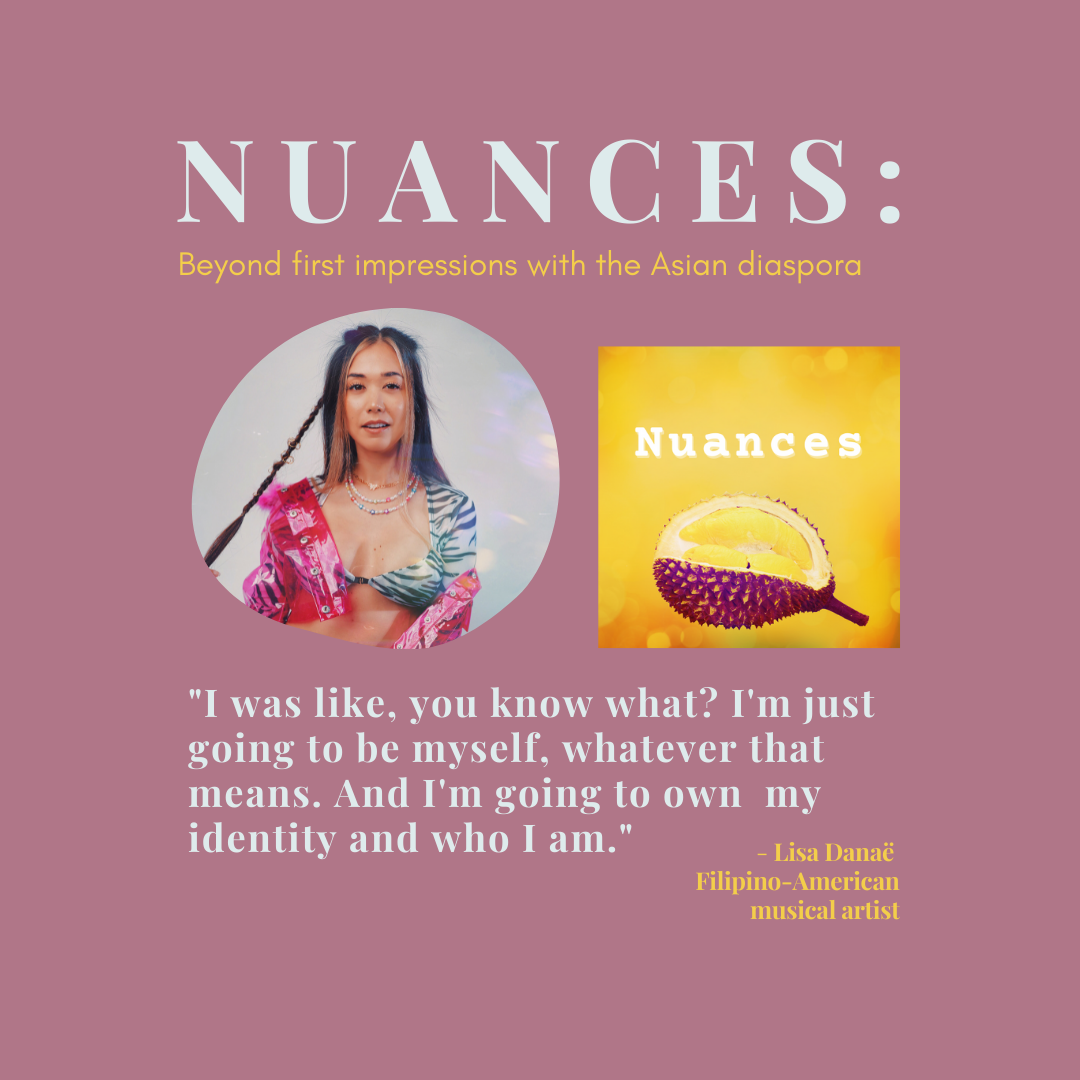
This week, Lisa Danaë chats with us about being mixed-race, trying to fit in the music industry both in the states and in the Philippines, and finally finding her voice and being accepted into the GRAMMY:NEXT program.
Guest bio
Hailing from California, Filipino-American artist Lisa Danaë has long been a powerhouse vocalist in the music industry. As she grew as an artist, Lisa’s goal became to spread her story of growth and empowerment through the same powerful pop hooks and unfeigned, timeless lyrics that she grew up listening to. Her ability to pay tribute to the late 90’s/Y2K pop movement while still honoring her musical tenure in R&B birthed her transition and curation of “dark pop”, where she uses deep sounds to balance the uplifting lyricism and create an addictive genre blend. Recently, Lisa was selected to participate in Grammy NEXT, and over the next year, it’s exciting to embark on this new phase of Lisa Danaë: resonant, audacious and unafraid.
Definitions
Colorism – prejudice or discrimination against individuals with a dark skin tone, typically among people of the same ethnic or racial group. For example, even within the Asian community, colorism still exists because Asians with light skin have more privilege than Asians with dark skin.
White-washing – having dissociated oneself from one’s ancestral culture by adopting or attempting to adopt a Western lifestyle. Being white-washed typically only applies to non-Caucasian people that live in Western countries. For example, an Asian person living in the Asian American diaspora, who doesn’t eat their ethnic foods nor speak their parents’ language, nor engages with their culture in anyway and only engages in mainstream American culture, would be called “whitewashed.”
Skin bleaching – The act of using substances, mixtures, or treatments to physically lighten one’s skin tone. Skin-bleaching is widespread in many Southeast Asian countries, due to colorist beauty standards.
White-passing – White-passing is when someone perceives a BIPOC person (Black, Indigenous and People of Color) as a white person, for whatever reason. For example, someone like Darren Criss, who is half-Filipino and half white, can be considered white-passing.
Tokenism – The practice of making only a perfunctory or symbolic effort to be inclusive to members of minority groups, especially by recruiting people from underrepresented groups in order to give the appearance of racial or gender equality within a workplace or educational context. Tokenism is not true inclusion; it is just an effort to give the appearance of diversity. In fiction, the token character can be based on ethnicity, religion, sexual orientation, or gender. Token characters are usually background characters, and, as such, are usually disposable, and are eliminated from the narrative early in the story, in order to enhance the drama, while conserving the main characters.
Token friend – Being the one BIPOC friend in a friend group. A token friend is a person who is added in a group so that other members of the group can feel good about themselves and can point to the token friend as “proof” that they are not racist.
This episode’s takeaways:
Takeaway #1
Even in diverse neighborhoods, kids get bullied for speaking a language other than English at school. Parents only teach their kids English so that they won’t accidentally use the wrong language at school and be made fun of as a result. If you are a white parent, we hope you will consider teaching your children not to make fun of kids who look or sound different, or bring different foods for lunch.
Takeaway #2
Being mixed race is a unique experience. It’s an in-between space where you wrestle with feeling Asian enough and white enough, and feeling less Asian than your relatives who are not mixed. Being half-white doesn’t get you white privilege. Whiteness is based on this idea of purity; being mixed race separates you from whiteness and you are still othered.
Takeaway #3
Not seeing yourself represented in a diversity campaign designed to promote people like you can feel even more alienating rather than empowering. Companies showing support for awareness campaigns such as AAPI heritage month can sometimes be counterproductive if their teams have not taken the time to fully understand the reason why such a campaign is needed in the first place and which sub-groups might especially be sensitive to being misrepresented or underrepresented. When Spotify used AAPI heritage month 2021 to just push all asian genre playlists, it was a clear indication that the company saw Asian Americans and Pacific Islanders as foreigners rather than Americans, conflating Asian American artists with “Asian artists”.
Takeaway #4
The Asian diaspora often feels a need to reconnect with their roots, a feeling which isn’t necessarily shared by their relatives who are still based in Asia.
Show notes
Lisa’s links:
- IG/TikTok @lisadanaemusic
- Twitter/Pinterest/Youtube: @lisadanae
- Website: https://www.lisadanae.com
- SoundScrub podcast: lisadanae.com/soundscrub
Filippino dishes mentioned:
Adobo: https://panlasangpinoy.com/filipino-chicken-adobo-recipe/
Lumpia: https://panlasangpinoy.com/longanisa-lumpiang-shanghai/
If you’d like to be featured or nominate a guest, please follow and DM us at @nuancespod. We will be releasing episodes every Sunday during AAPI Heritage Month (May) and Pride Month (June). Hosts: Ariadne Mila & Sherry-Lynn Lee
Leave a Reply